Week 9 | Space and Art |
The relationship between art and space has been vague to me until I learn all the fascinating materials in this week's lecture. According to professor Vesna, the introduction of space begins with the heliocentric model theory addressed by Nicolaus Copernicus.
The theory is that the sun is in the center of the solar system, and all other planets orbit around the sun. They are different theories about space until the telescope was introduced to the world, scientists greatly expanded the understanding of space.
 With the launch of Sputnik, the Space race, and the creation of NASA, human challenged their limits and changed the world and the future of the United States. The nation put a lot of research and time on space and students got more education in math and science to make changes. After then, people sent the dog, monkeys, and human to space. Yuri Gagarin began the first human to journey into outer space.

 When I think of this topic, I remembered the light show that I visited in Shanghai. The show used all different kinds of lights to create the look of space. When you stand in front of the light, you are like floating in the apace

In my own experience, I watched a lot of space-related movies, such as the Guardians of Galaxy and Star Trek, and I think these scientific and fictional movies provided the younger generation the curiosity and the passion to space. I think there is still a huge part of the space puzzles did not solve by a human, and our generation can be the one to unfold the map.
Wilkinson, Alissa. “Arrival Is a Stunning Science Fiction Movie with Deep Implications for Today.” Vox, Vox, 11 Nov. 2016, www.vox.com/culture/2016/11/11/13587262/arrival-movie-review-amy-adams-denis-villeneuve.
Johnson, B.E. “Space & Astronomical Art.” The Space Art of B.E.Johnson, imperialearth.com/pimaget.php?filename=newhorizon600.jpg.
Forsythe, William. “ Antipodes I/II.” Dancing on the Ceiling: Art & Zero Gravity Curated by Kathleen Forde : EMPAC Curtis R. Priem Experimental Media and Performing Arts Center : Troy, NY USA, zerogravity.empac.rpi.edu/forsythe/.
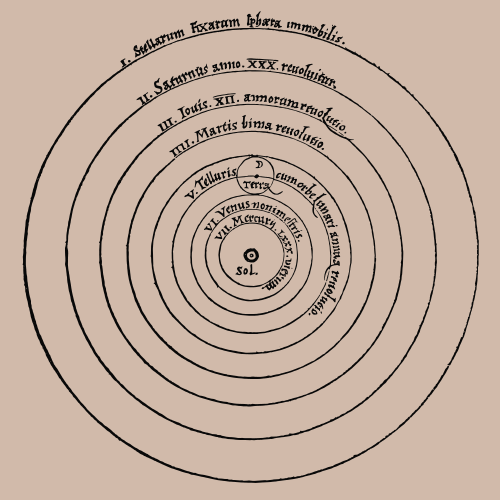 |
| Heliocentric Model |
The theory is that the sun is in the center of the solar system, and all other planets orbit around the sun. They are different theories about space until the telescope was introduced to the world, scientists greatly expanded the understanding of space.
The zero gravity enables the dancer to look lighter and more flexible in the air. I found many examples of artwork related to zero gravity.
 With the launch of Sputnik, the Space race, and the creation of NASA, human challenged their limits and changed the world and the future of the United States. The nation put a lot of research and time on space and students got more education in math and science to make changes. After then, people sent the dog, monkeys, and human to space. Yuri Gagarin began the first human to journey into outer space.
When I was reading this week's material, William Forsythe's artwork leaves me a great impression. Art and Space can be related by portraying people under zero gravity with the beauty from ballet. He presents this concept beautifully to the audience, bringing people the idea of zero gravity vividly with a beautiful sense.
In my own experience, I watched a lot of space-related movies, such as the Guardians of Galaxy and Star Trek, and I think these scientific and fictional movies provided the younger generation the curiosity and the passion to space. I think there is still a huge part of the space puzzles did not solve by a human, and our generation can be the one to unfold the map.
Works Cited
Vesna, Victoria. “Space + Art | Lectures.” YouTube, YouTube, 29 July 2013, www.youtube.com/watch?v=4WOqt_C55Mk.
“Motion.” Geocentric and Heliocentric Models | Motion | Space FM, www.space.fm/astronomy/planetarysystems/geocentricheliocentric.html.
Michael, Sage “Sputnik.” Beyond Geek, 8 Apr. 2015, www.beyondgeek.com/sputnik/.
Johnson, B.E. “Space & Astronomical Art.” The Space Art of B.E.Johnson, imperialearth.com/pimaget.php?filename=newhorizon600.jpg.
Forsythe, William. “ Antipodes I/II.” Dancing on the Ceiling: Art & Zero Gravity Curated by Kathleen Forde : EMPAC Curtis R. Priem Experimental Media and Performing Arts Center : Troy, NY USA, zerogravity.empac.rpi.edu/forsythe/.


Comments
Post a Comment